
“No to Obama, Yes to the Cathedral!”
Orthodox activists clash with local protesters over church construction in a Moscow park
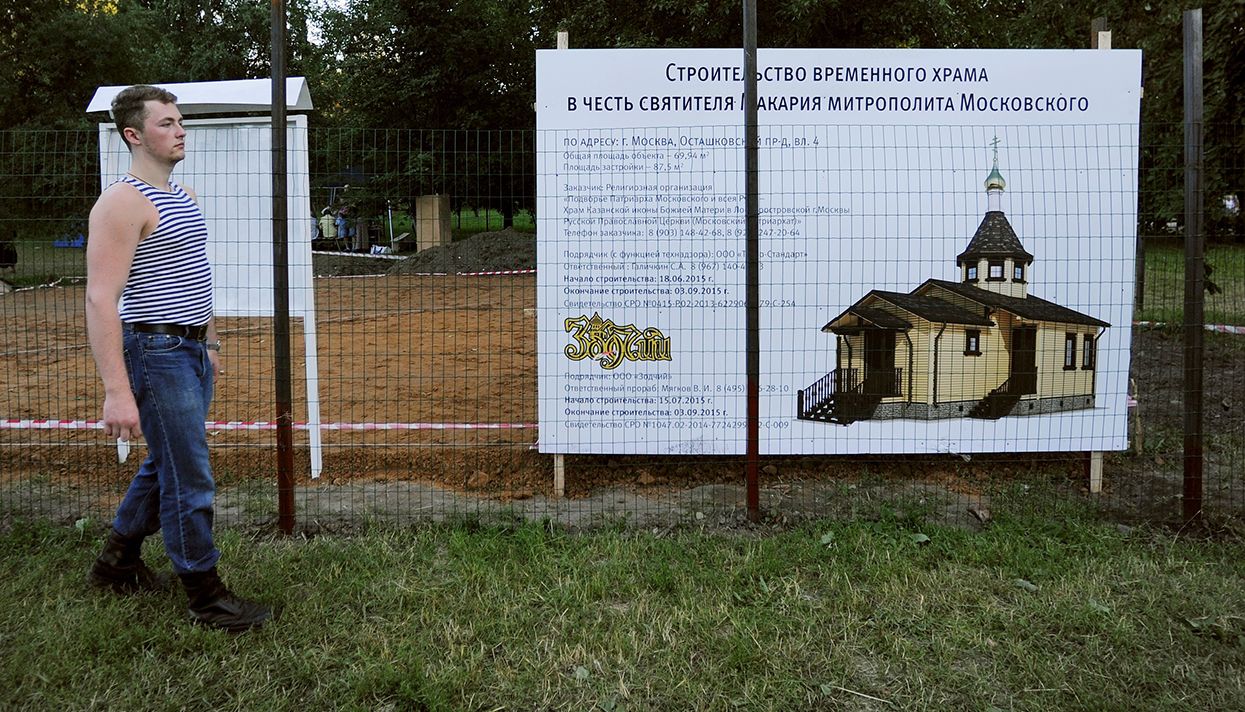
In a northeastern district of Moscow, locals have been fighting against the construction of an Orthodox cathedral in Torfyanka Park. Ever since the project was proposed, it was met with some resistance, but lately the conflict has entered a whole new “militant phase.” Some of the local residents have come out in support of the church, while others remain staunchly opposed. Those who oppose it are supported by Russia’s political opposition, while the supporters are rallied by an increasingly aggressive Orthodox Church. Over the course of one week, daily clashes took place between citizens and the police. Both sides have pitched tents in the park on the contested site. Government officials have also been paying close attention to these developments. On Thursday, June 25, at a local prefecture meeting in the city district, it was decided to halt construction of the cathedral. Opponents of the construction were overjoyed, while supporters of the cathedral were furious. People from both sides were arrested by the police. Meduza’s special correspondent Andrei Kozenko reports.
Torfyanka is a typical Moscow park in a residential district, a couple of kilometers from the Babushkinskaya Metro Station. Trash lines its gravel paths. But locals love it. Parents push strollers with napping children as dog-walkers briskly pass by them. In the summer, people go fishing in the park’s small pond. In the winter, the park is filled with recreational cross country skiers.
But today, part of the park is fenced off. The curbs nearby have been broken up to allow trucks to move building material in more easily. A cross stands two meters high inside the fenced-off territory. Around the cross are people dressed in identical reflective vests; they tell me they are construction workers. Outside the fence stands a short-haired man wearing sneakers, track pants, and a black shirt. He’s holding an open hardcover book and muttering something under his breath. Then he crosses himself, bows his head, and walks off.
He goes by the name Pytor. He’s a student at one of Moscow’s medical universities. He came across a video online which shows the controversy surrounding the cathedral’s construction, and he came over to have a look. “I really want to go up to these enemies and say to their faces, ‘If it weren’t for my Christian humility, I would slash your bodies! I’d bury you alive!’” he tells me.
“That’s not the best way to start a dialogue,” I venture.
“I don’t want to talk to them. I don’t even want to look at them,” he insists. “That video showed a woman with a child who was swearing at the Orthodox Christian people. Their citizenship should be taken away and they should be sent off to Europe! Let them practice their godless faith there!”
I try to tell him these people have nothing against cathedrals, they just don’t want one in their park.
“People lived in small bungalows and erected buildings ten times bigger for God,” the student insisted. “So if you build Moscow-City [Moscow’s skyscraper business district], then God should get cathedrals ten times the size of Moscow-City!”
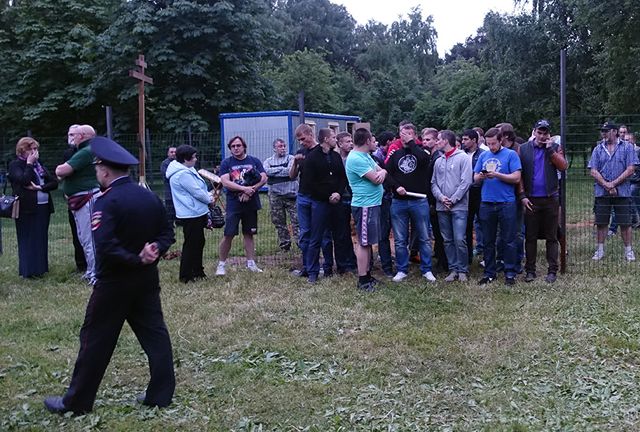
The construction of the “Cathedral of the Kazan Icon of the Blessed Mother” in Torfyanka Park is part of the notorious “200 Cathedrals” plan. The plan was drawn up under previous Moscow mayor Yuri Luzkhkov and has been set into action under the new mayor, Sergei Sobyanin. The aim is to erect enough churches in the city’s residential areas so that there is always a church within walking distance of anyone’s home. The program is led by a well-known developer, state official and politician Vladimir Resin, who has access to a budget of many billions of rubles per year. The cathedral in Torfyanka is part of the program, and its construction will take up 0.2 hectares of park land. But this relatively small construction project has attracted such staunch local opposition that the spotlight is on the whole program.
The local conflict began sporadically back in 2012. In accordance with Russian law, public hearings were held before the new construction was to start. But the results of the hearings never made it into the local media; most notably, the famous local newspaper Losinka did not publish anything on the topic. A group of concerned citizens appealed the construction decision in a local district court, saying that protocol was violated because the hearings were not reported. But the court overruled the appeal. The locals went on to take their lawsuit to a Moscow city court, but the city court redirected the appeal back to its original jurisdiction. At the same time, the Prosecutor’s Office demanded that the district council rectify the procedural violation.
“From a legal point of view, the case is bulletproof,” says Ivan Medvedev, a lawyer representing the opponents of the cathedral’s construction. “I haven’t seen so much evidence in ages. The prosecutor’s inspection; the recognition of a violation by the district’s council; the sacking of people who had prepared the hearing. They have notarized reports of the council’s website which featured nothing of the hearings; they have an empty newspaper which was supposed to have reported on the issue. Over one thousand residents maintain they never knew of any hearings.”
In spite of overwhelming evidence of procedural violations, construction began on June 18, 2015. A fence was erected in the park, and the first layer of sand was spread over the allocated building site. That very evening, the first angry locals appeared. They blocked the paths of arriving construction equipment with their cars. They were met by those same muscular people in the reflective vests - not construction workers, but rather Orthodox church activists from the movement called “The Forty Forties” (an old poetic term referring to the 1,600 historic churches which allegedly used to stand in Moscow). Some of the locals also came out in favor of the construction. The cathedral has divided the locals into two camps, and now the park is a special place where people come to brawl. Since the construction began, fights and arguments have taken place here daily.
On Tuesday, June 24, Patriarch Kirill, the head of the Orthodox Church, finally commented on the issue. “I call on Orthodox believers during this time to avoid the cathedral’s proposed construction site so as not to give into provocations, and, more importantly, confrontations with opponents of the construction,” he said. It quickly became obvious that his call for peace would be entirely ignored.
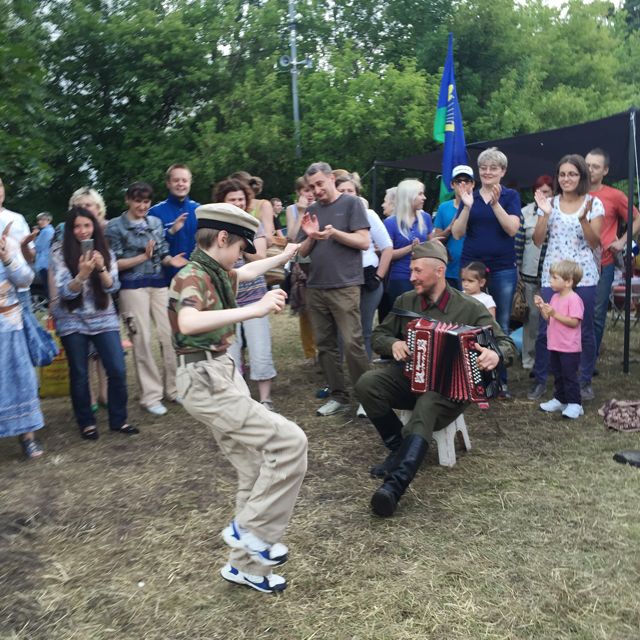
The next day after the Patriarch’s speech, I walked along the fence in the park. People had hung leaflets on it. “No to Obama, No to Maidan, Yes to the Cathedral!” said one of the papers. The word “Maidan,” which usually refers to the 2014 protests in Kiev, was used here to refer to a large tent where 10 people had gathered. Another two dozen people were hanging out nearby or lounging on the grass. At a certain point, Russia’s riot police (the OMON) burst into the park, tore down the tent, and arrested several people. But within an hour, the tent was back up, and all the same people were sitting under it again. A man in a World War II military uniform had an accordion and was playing an old song called “Our Proud Varyag Won’t Surrender to the Enemy;” some local grandmothers had gathered around to listen.
One of the older women, Larisa Yeliseyeva, told me that there was once a small boat house at the pond in this park. But the park had never had a church. The nearest cathedral had been built in 1916 a few blocks away; it was demolished in the late 1920s by the Bolshevik government. On June 18 during her evening walk, Yeliseyeva heard noise coming from the park, went to have a look, and discovered workers were closing off part of the area. Yeliseyeva says she’s no atheist, but she doesn’t like the idea of a cathedral here. She’s become a regular participant in the protests, and other locals agree with what she says. A woman who had always walked her dog in the park for a full decade decided she didn’t like the construction either. Now this woman spends all of her copious amounts of free time here too.
Yeliseyeva says she’s only heard rude things from these “Orthodox activists” who’ve set up camp inside the construction site, the entrance to which is guarded by the police. “It’s amazing how rude they are. Why do they think that if I am simply defending my park, I have automatically become an enemy of Russia and an agent of America?” she asks.
Ilya Akhromeyev, the man in the old military uniform with the accordion, is certain that the arrival of the police was caused by a dispute over porta-potties. “The Orthodox people’s toilets were nearly overflowing... We wouldn’t let the porta-potty extraction truck in. So they started dragging in a new porta-potty. Our side started to object, and then the police got involved,” he says.
“Why do you wear in a military uniform?” I venture cautiously.
“This is the uniform of my great-grandfather,” Akhromeyev answers. “He was killed in 1942. Now the time has come to put it on again, because this is war. We’re uniting against occupation forces on our own land.”
Our conversation is interrupted by shouting. Just a few feet away from us, another skirmish has begun. A group of men is shouting at a young woman with a child. Both sides are calling for the police. The young woman is led away from the conflict by another woman in a bright green blazer with St. George’s ribbon on the lapel (a Russian pro-government patriotic symbol). I approach them and ask them if everything is alright.
“They’ve been watching Europe, and they’ve lost their minds,” the young woman answers. “They also want to teach their kids that same-sex marriages are okay!”
“Look over there at the woman in red,” the woman in the green blazer, whose name is Tatyana Fortunatova, points towards the crowd. “That’s my friend Natasha. We’ve been friends for 40 years, since we were kids in school. We hadn’t seen each other in ages! And I see her and I yell, ‘Natasha!’ And she says to me, ‘are you for the cathedral or against it?’ I tell her, ‘I support the cathedral, of course.’ And she spat at my feet! Can you believe that? And then she turned away from me. Her new friends say we’re an ‘Orthodox cult.’”
The day after that, even stranger things began to happen in the park. A woman went into the crowd of protestors against the cathedral and began to shout that she was an architect suffering financial losses from the construction delays. People began asking her questions, but she left with the words “No interviews today.” A man with a beard wearing traditional Cossack clothing started waving a flag with a picture of some sort of Saint on it. “Christ never bothered anyone, and I won’t bother anyone,” he mumbled as he waved his flag, and went on: “I want to introduce myself - I am Ustinov Dmitry, 66 years old, a Cossack, I fought in Transnistria and in Novorossiya [eastern Ukraine].”
“Listen here, you phony,” yells someone from protesters’ camp. “This is a diverse crowd, and not everyone here supports the idea of killing Ukrainians. So maybe you should keep your life story to yourself.”
Off to the side, a young man in a gray shirt with a short beard is being interviewed by a TV channel. “Protesting against the cathedral is the same as protesting against the country,” he says theatrically. “I feel genuinely sorry for these people. It’s so sad that locals don’t know that everything good in our history is connected to Orthodoxy. These uncultured locals don’t know their history. All they can think about is a pair of new jeans and shopping malls. This is a fight of the spiritual against the material.”
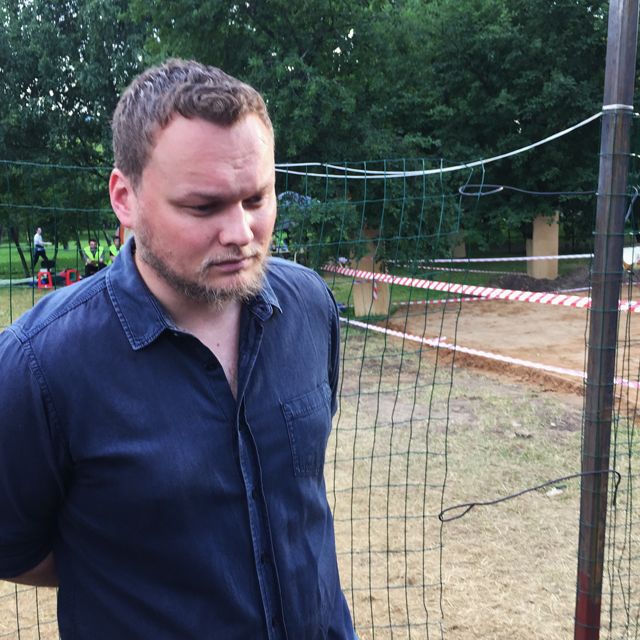
I recognize the man, but can’t recall his name. So I go over and ask. “Ivan Katanayev,” he answers. “I’m a resident of Moscow.”
Resident Katanayev goes by the nickname “Combat” and is one of the founders of “Fraternity,” the most powerful organization of soccer fans of Moscow’s Spartak soccer club. About five years ago, he was known as their leader and their main spokesperson, but was implicated in a money laundering scheme and kicked out of the group. He spent while hiding out in Central Asia before returning to Russia. Katanayev refuses to speak with me. “I won’t comment for the news source you work for,” he says.
At 7 PM, Sergei Mitrokhin, the leader of Russia’s liberal Yabloko party, arrives at the park from the prefecture. Both Yabloko and the Russian Communist party had tried to reap benefits from supporting the protesters from day one. “Well now! How much money have you gotten from selling off Russia to the global cabal?” the Orthodox camp sarcastically greets the leader of Yabloko. Mitrokhin smiles. He says through a loudspeaker that he’s come from a hearing at the local prefecture, and he brings good news.
“A decision has been made to stop all construction work until a court ruling is reached,” he announces. “All the tents, enclosures, all the construction equipment must be removed by morning.” Mitrokhin gathers an audience of two hundred people. People have come to the park on their way home from work. Most are cheering. Some are chanting “shame! shame!”
“Show me your documents!” splutters Katanayev at Mitrokhin, adding “Moron! Traitor! Go back to America!”
The head of the local neighborhood council, Pavel Litovchenko, has also arrived at the scene. The defenders of the cathedral try to rush over to him, but the official disappears immediately with the words “Everyone, remain calm!”
As usual, the crowd is anything but calm. Mitrokhin repeats his instructions to remove all tents by morning; he had promised the Department of Regional Safety Chief at the mayor’s office that no one would camp here anymore. Someone from the crowd tries to splash a mysterious white liquid in Mitrokhin’s face. Judging by its consistency, it’s kefir, a kind of yogurt drink. But they miss and hit a man holding a camera instead. The man gets worked up and starts aggressively picking a fight with people from the crowd.
A priest approaches the Orthodox protestors. “I bless you to disperse,” he declares to the angry mob.
“What’s his name?” I ask a woman standing beside me.
“I don’t know,” she answers sharply. “I’m not with them.”
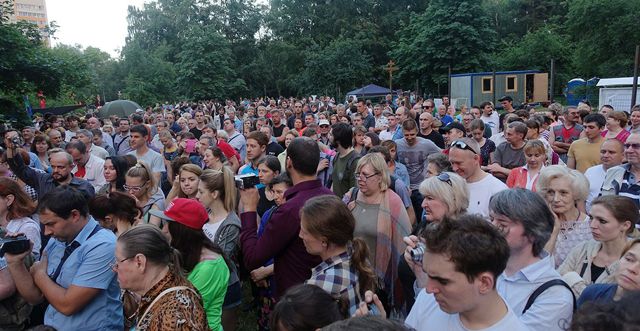
An hour later, local politicians start arriving for a scheduled demonstration at the site.
Most of them are from the Communist party. Ilya Akhromeyev, the uniformed man with the accordion (and generally everyone’s favorite person), hasn’t put down his musical instrument all this time, and has gathered a whole choir of local grandmothers. “Don’t get in the water if you don’t know how deep it is!” sing ten schadenfreude-laden voices, clearly directing their ominous song at the cathedral’s defenders. There’s already more than one thousand people here. Police randomly arrest a few people despite the fact that the protest is sanctioned. A group of left-wing activists, veterans of the Khimki forest ecological protests from 2010, are led into police trucks, as are Katanayev and some people from Yabloko. According to OVD-Info, and organization which monitors arrests at protests, over 20 people were arrested that evening.
The opposing sides ended up spending the night at the park. No one wants to be first to dismantle their tents and leave. Medvedev, the lawyer of those who oppose the cathedral, is skeptical about the prefecture’s trustworthiness. “The prefecture didn’t make the decision to build the cathedral, so it’s not up to the prefecture to stop the construction. This isn’t over.”
Andrey Kozenko
Moscow