
‘Dasha, don't wait around. There won't be any money. Make a run for it.’
Russia's Sbarro employees describe life without wages for six months
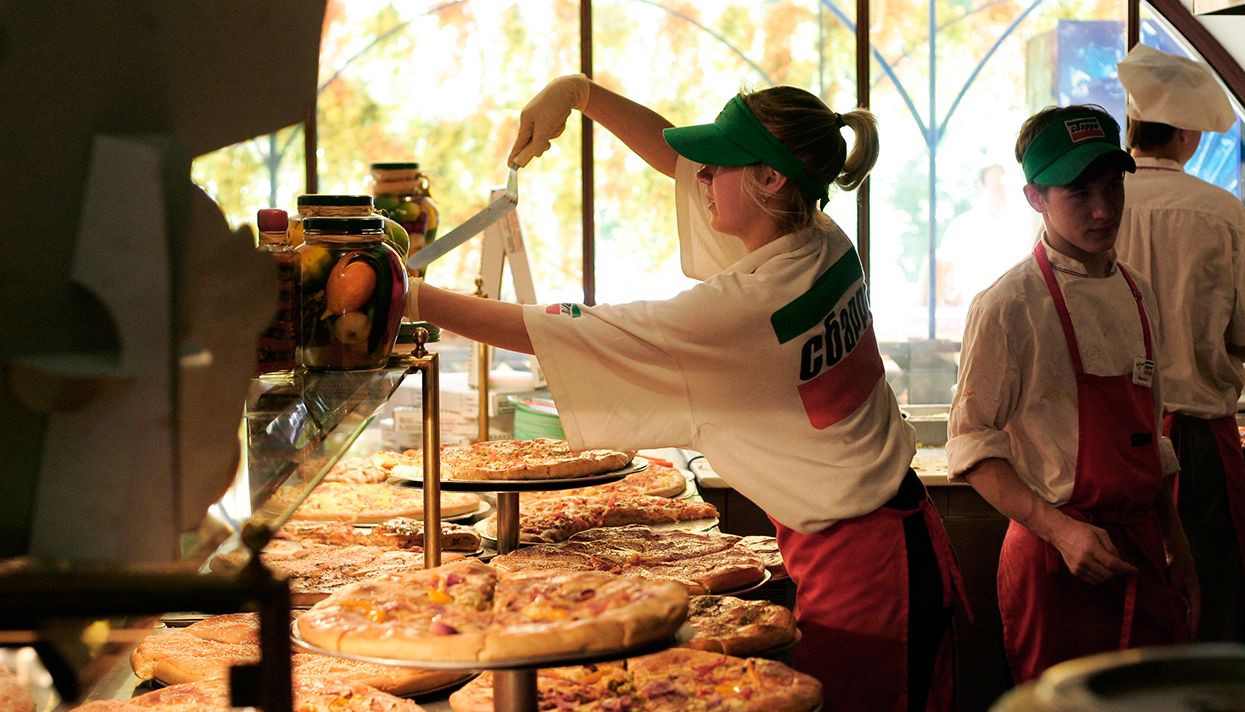
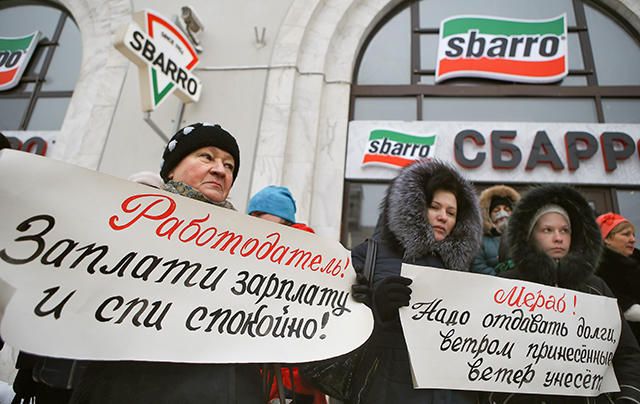
For more than six months, the employees of the Sbarro restaurant chain in Russia haven't been paid. Many of these people are migrants, hired through special agencies, and they've found little legal recourse. Like many Russian workers before them, these cashiers, waiters, and managers have appealed to President Putin in an open letter. They're also picketing and some have even declared a hunger strike. The holding company that owns Sbarro's Russian franchises, Planet Hospitality, says it's suffered because of Russian food sanctions against the West and a decline in consumer demand, but it assures staff that the situation will improve, and it even promises to open new restaurants later this year. Meduza collects the stories of several Sbarro employees, who have survived the past six months without almost any money or hope.
Jasmine Magomedkerimova, manager
I first worked as a cashier [at Sbarro] on Manezhnaya Square [in Moscow]. Then I became a manager, and I was transferred to the restaurant at the Otradnoe metro station. In early December, the location was closed for failure to pay the rent—the company owed at least 3 million [rubles, or $38,000]. They wanted to shut us down as early as September, but the bosses managed to come to some agreement then.
I haven't been paid since July. They tell me that I'll get it in pieces, at some point. The top management doesn't talk to us, including the company's general director. They don't let us into their office. That's why we're picketing. We're fighting for our own damned money. And we don't know if we'll ever get it. I'm owed about 200,000 rubles [$2,500]. I submitted a statement saying I won't work another day until the company pays me my salary. My immediate superior took the statement and signed it. The thing is, I (like many other staff) didn't work for Sbarro directly—I was employed through a recruitment agency. [Such agencies hire migrants for work in the food industry, where “directly employing” them is illegal in Russia.] The company also owes money to these agencies, which tell us that their hands are tied, because they haven't gotten their money, either.
According to some insiders familiar with the situation, top managers at Sbarro's Russian chain are hardly struggling. They say the CEO recently spent several millions on his nephew's wedding, and soon his daughter is getting married, too. He once met with us wearing a gold watch that bore an emerald-studded “Planet Hospitality” emblem. All the people in his office—every last one of them—are getting their salaries, but the ordinary hired hands like us are left with nothing.
Asiyat Atlaskirova, cashier
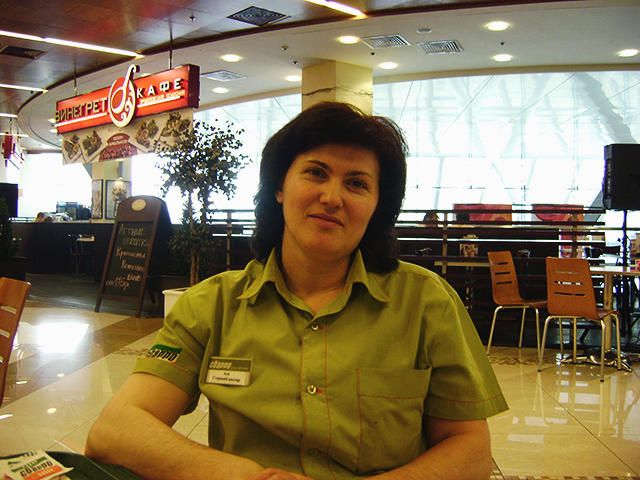
My story is the same as everyone else's: they've been holding my wages, and now I'm owed about 150,000 rubles [$1,900]. They closed down our restaurant on December 15. It will be a big shame, if we don't get our money. These days, we're covering shifts for two people (sometimes three), just hoping for the best. I'm one of the older employees. All the younger ones didn't stick around. They came and left. Only the managers, one pizza maker, and I have remained. None of us has received any pay.
All in all, I've worked almost six years as a cashier at Sbarro. After so long, what kind of owner wouldn't be interested in his people? In how they live? The Labor and Employment Service and the Labor Inspectorate know about us. So does the Attorney General and the State Duma. We've gone through nearly every agency by now, and one person even wrote a letter to Putin. Hope dies last, as they say. But I don't know if the letter to the president will help.
Right now, I'm not working at all. I injured my hand when I was taking out the garbage. At the time, there were only two people working the whole restaurant. The manager and I were doing everything ourselves. Later, my hand started going numb. I'd pinched a nerve.
Alexandra Parshina, administrator
Of all the people employed at this company, only two have been paid their salaries through December, as far as I know. But management seems to have reported to the Labor and Employment Service that it's paid roughly 50 percent of the wage arrears. Except I know at least 60 people who are still owed money. Many of us joined a union, which is helping us now. It keeps us informed. Some people are afraid to join. Others say it's no use.
I still haven't quit. I want to know the situation from the inside. The thing is that we received small fixed salaries, and everything else was awarded as bonuses. If we take this to court, the only thing we could win is the formal wage arrears. Some employees were making 7,000 rubles [$88] in monthly wages, formally, and about 25,000 rubles [$315] in bonuses.
I think we need an advocacy group composed of a few people to coordinate all further actions. The management is ignoring us, so we should at least be able to make this fight official.
Daria Malovichko, restaurant manager
I haven't been paid for September, October, November, or December. I was owed 200,000 rubles [$2,515]. They've paid me back some of it, but I'm still owed 120,000 rubles [$1,500]. I was a Sbarro manager. One of these days, I'll go back for my things. I've already found a new job.
I tried to get in direct contact with the company's general director, but nothing came of it. Many of our employees live in rented apartments, having arrived in Moscow in search of work. Most of them want to leave. They're not even hoping to get anything now. The top management has stopped communicating with us entirely.
We staged a protest, and our security guard showed up. After we asked him just a few questions, he turned around and ran away. All we wanted to know was when we'd be getting our money.
I can't say why all this has happened. I think there were a number of factors. We always gave the cash collectors the minimum that you were supposed to report, and the rest of the money went in cash to people who would come from the central office. At some point last summer, I realized that various managers were starting to leave the company. They told me, ‘Dasha, don't wait around. There won't be any money. Make a run for it.’ That was when I started to get nervous.
Elena Ospanova, restaurant manager
I worked for the company for more than seven years. The last six months, I had problems with my salary. They'd pay me in bits, transferring a thousand [$13] here and five thousand [$64] there. The last time I was paid was in September, when they transferred me 6,000 rubles [$77]. For the last five months, they owe me—a manager—220,000 rubles [$2,800]. When all this started, our direct supervisors—the top managers and financial directors—called us to a meeting and said everything would be okay. They said there wasn't any money then, but everything would be fine, if we kept working. They weren't interested in how we were supposed to live without wages, though that's exactly what we asked them. The only answer they gave was that we'd get the money, if we performed at least 80 percent of our work hours. Nobody cared that Sbarro's quality of service plummeted. When customers complained, they yelled at us—the ordinary workers.

They explained it to us like this: now the financial crisis has hit us, too. But really I don't know what happened. Maybe it was the crisis, but there were other strange, unexplained things. For example, we had ingredient shortages and even ran low on condiments. I'm sorry to say it, but there were meat pizzas with barely any meat. We appealed to the top managers, telling them to make things like they used to be. They told us that it wasn't our place to boss them around. The whole staff of our restaurant quit together: 16 people, including the managers. Everyone quit on the same day, and the restaurant was closed for failure to pay the rent. Now people are just sitting at home, waiting.