
The case against Russia's ‘extremist librarian’
How the head of Moscow's Ukrainian literature library landed in court
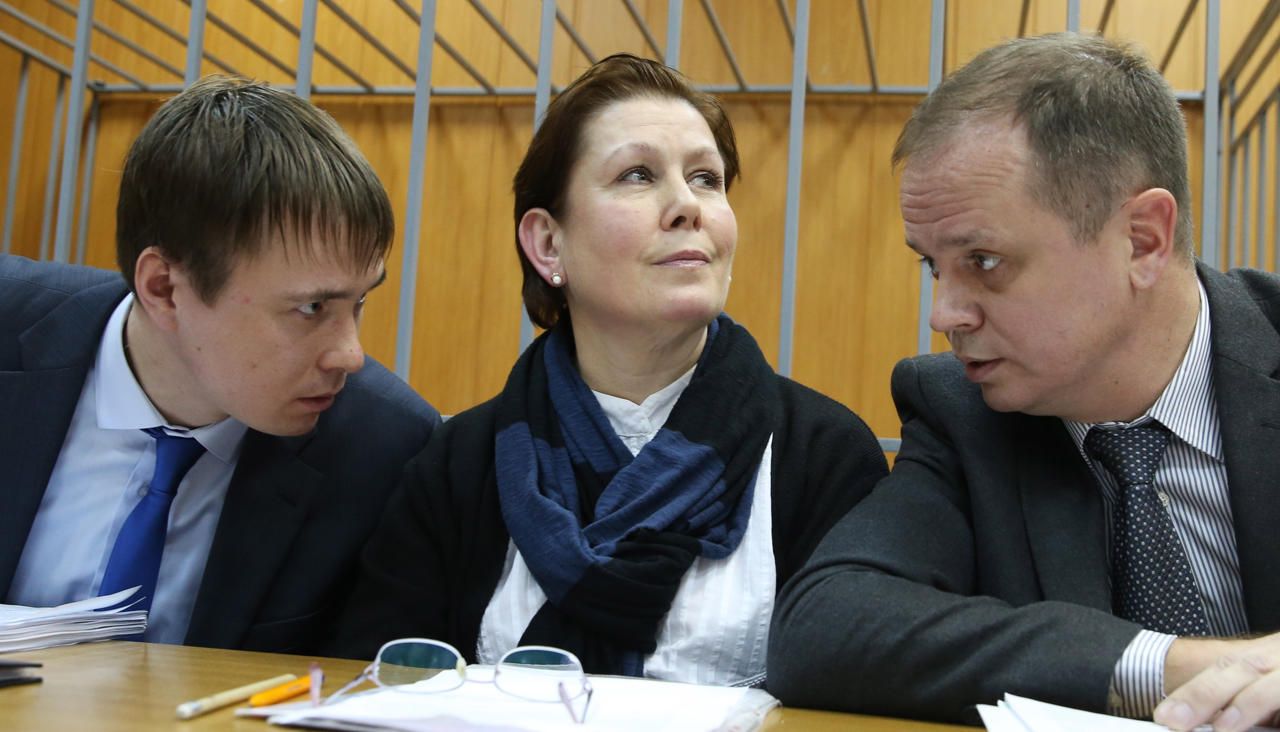
On Monday, May 29, a Moscow court heard closing arguments in the case against the former director of the Library of Ukrainian Literature, Natalia Sharina, who stands accused of distributing extremist materials and embezzling government funds. State prosecutors asked the judge to give her a five-year suspended sentence — an act of “mercy” that elicited facetious thanks from Sharina’s lawyers, who argue that their client should be acquitted. Meduza examines the case and reviews the history of this supposedly criminal librarian.
The oral arguments in Russia’s “Librarian’s Case” lasted about three hours on Monday. Prosecutor Lyudmila Baladina began with remarks about the embezzlement charges against Sharina, but she prefaced her speech with her own assessment of the political situation in Ukraine, where she says two powerful forces are now duking it out: “the pro-Russian side and the pro-Western side.” People in the latter camp, Baladina explained, advocate a close alliance with NATO members and blame the Russian leadership and Russian people for Ukraine’s underdevelopment.
The prosecutor told the court that Sharina was appointed as the director of the Library of Ukrainian Literature in 2007 “to ensure that the institution’s activities correspond to the interests of Russia.” In December 2010, however, police raided the library and discovered a copy of the book “War in the Crowd” by Dmytro Korchynsky, leading to charges of extremism, despite the fact that Korchynsky’s book wasn’t banned in Russia until 2013. A lawyer named Alexander Yekim was hired to defend the library, but he ultimately represented Sharina exclusively, prosecutors say, and the government paid him 297,000 rubles ($5,250) for his services. This is how the embezzlement allegations against Sharina got started.
Prosecutors say Sharina also embezzled money to pay for legal services a second time, claiming that she hired two attorneys the library didn’t need, paying them more than 1 million rubles ($17,600), though investigators could find no documents showing that either lawyer performed any work. Baladina told the court on Monday that the attorneys’ phone numbers weren’t even listed in Sharina’s contacts on her mobile phone.
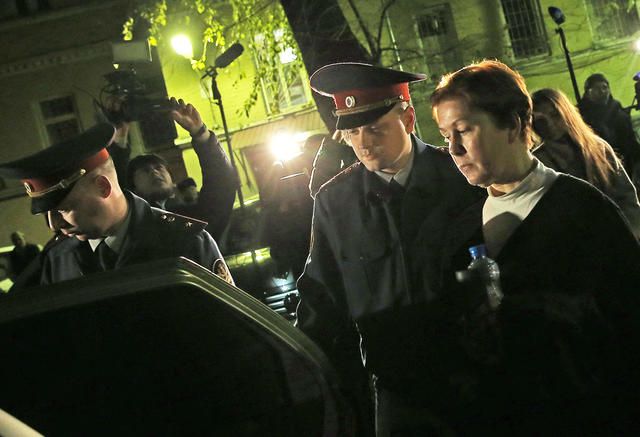
In October 2015, the police returned to the Library of Ukrainian Literature in a new search for extremist materials, this time seizing 275 books and two compact discs. According to Baladina, these materials “contained derogatory qualities and negative emotional assessments inciting ethnic hatred against Russians,” including some open calls for armed violence. At least in part, prosecutors were referring again to books by Dmytro Korchynsky.
Speaking to Meduza, Sharina’s colleagues accused the police of planting these books.
“According to the library’s staff, several of the seized books were in special storage, where visitors couldn’t enter. But it was never specified if the books could be removed by special request,” Baladina told the court, citing witness testimony claiming that visitors could in fact get permission to see these books.
Baladina also denied allegations that the police planted extremist literature in the library, attributing the claim to Sharina’s defense team, and insisting that there are no grounds to doubt what investigators discovered.
The prosecutor concluded her remarks with another allusion to world politics: “Ukrainian nationalism went hand in hand with German fascism, and it has again reared its head today, when those who usurped power openly talk about seizing Russian regions. They are actually destroying the Russian population. And the defendant is one of the mechanisms for disseminating their ideas,” Baladina said.
In response, Ivan Pavlov, Sharina’s lawyer, told the court that the prosecution’s extremism charges are vague at best, saying the state has failed to prove that a criminal act in fact took place. “The prosecution’s case doesn’t allow us to understand what crimes exactly Sharina is accused of committing,” Pavlov argued, saying the defendant did nothing to disseminate extremist materials, and telling the court that it can’t treat her inaction as an act of extremism.
“The mere presence of such materials isn’t enough to accuse someone of a crime and find them guilty. There must be direct intent, and there’s not a shred of evidence in this case that Sharina was fixated on this goal,” Pavlov said.
The attorney also pointed out that Sharina’s duties as library director didn’t include book selection. “My client does not speak Ukrainian, and therefore she couldn’t have spread Ukrainian-language literature in order to incite hatred,” Pavlov said, asking the court for an acquittal on the grounds that no crime was committed.
Sharina’s lawyer called the embezzlement charges against her “absurd and cynical,” as well as an “attempt to punish her for exercising her right to legal assistance by hiring a professional lawyer to defend her.” “The defense of a legal entity encompasses the defense of its management, including its director,” he argued.
Evgeny Smirnov, Sharina’s second lawyer, presented the court with evidence of a large number of procedural violations committed by state investigators during their raid on the library in October 2015. “Sharina’s right to defense was violated, and she was also denied hospitalization, over the urging of paramedics,” Smirnov said.
Earlier in Sharina’s trial, on May 25, her legal team revealed that she sustained a spinal compression fracture in October 2015, after her detention, while being transported in a police car.
Smirnov also addressed the case’s political subtext: the police raid on the library in 2010 immediately followed the Ukrainian Attorney General’s announcement that it was opening a criminal case against the Soviet authorities for the Holodomor famine in 1932 and 1933; and the 2015 raid came as tensions heated up again in the Russian-Ukrainian conflict.
“You’re ascribing functions to the library that it simply doesn’t have. The library doesn’t have the authority to censor legally published books, and yet you attribute this responsibility to me,” Sharina told the court, adding that anyone with an Internet connection can find Korchynsky’s book in an instant.
Responding to the embezzlement charges, Sharina said she was ordered to hire new lawyers by Moscow’s Culture Department (which incidentally transferred the library to the city’s Interethnic Affairs Department, after the police raid in 2015).
Defending her organization, Sharina also said the Library of Ukrainian Literature was for almost 15 years one of the only cultural centers in Moscow that “played a big role in Russian-Ukrainian relations.” “I am ashamed,” Sharina told the court, “that a cultural institution created [in the 1980s] and inspired by Soviet culture has been destroyed for the interests of a small handful of people. I request that I be acquitted, and I’m not even asking for apologies or restitution.”
Sharina’s verdict and sentence will be announced on Thursday, June 1.
Russian text by Sasha Sulim, translated by Kevin Rothrock