
The Real Russia. Today.
Another bodyguarvenor calls it quits, a GRU veteran is murdered by Armenian nationals, and Big Book prize finalists are announced
Wednesday, June 5, 2019
This day in history: 20 years ago, on June 5, 1998, Russian figure skater Yulia Lipnitskaya was born in Yekaterinburg. She was part of the Russian crew to win the 2014 Winter Olympics team trophy. She retired from the sport in August 2017, at the age of 19, due to complications with anorexia.
- Putin has appointed four of his bodyguards to be regional governors. Two have already quit.
- Yekaterinburg journalists organize a ‘funeral for freedom,’ spray-painting graves for Russians' rights
- Newly renamed A.S. Pushkin Sheremetyevo Airport gets a monument to the groundbreaking poet
- Four men reportedly arrested, following murder of former Russian military intelligence officer
- Opinion: Columnist Oleg Kashin wonders why the GRU killing hasn't sparked ethnic riots
- Opinion: Former diplomat Vladimir Frolov thinks the upcoming Jerusalem summit is a chance for Moscow to deal on its Iran influence
- Opinion: Columnist Dmitry Steshin says a Ukrainian joining Facebook's public policy team spells trouble for Russians
- Finalists announced for Russia's prestigious Big Book prize
- Three former soldiers are suing Russia's Defense Ministry for nearly killing them in a tank exercise
Putin has appointed four of his bodyguards to be regional governors. Two have already quit. 🍂
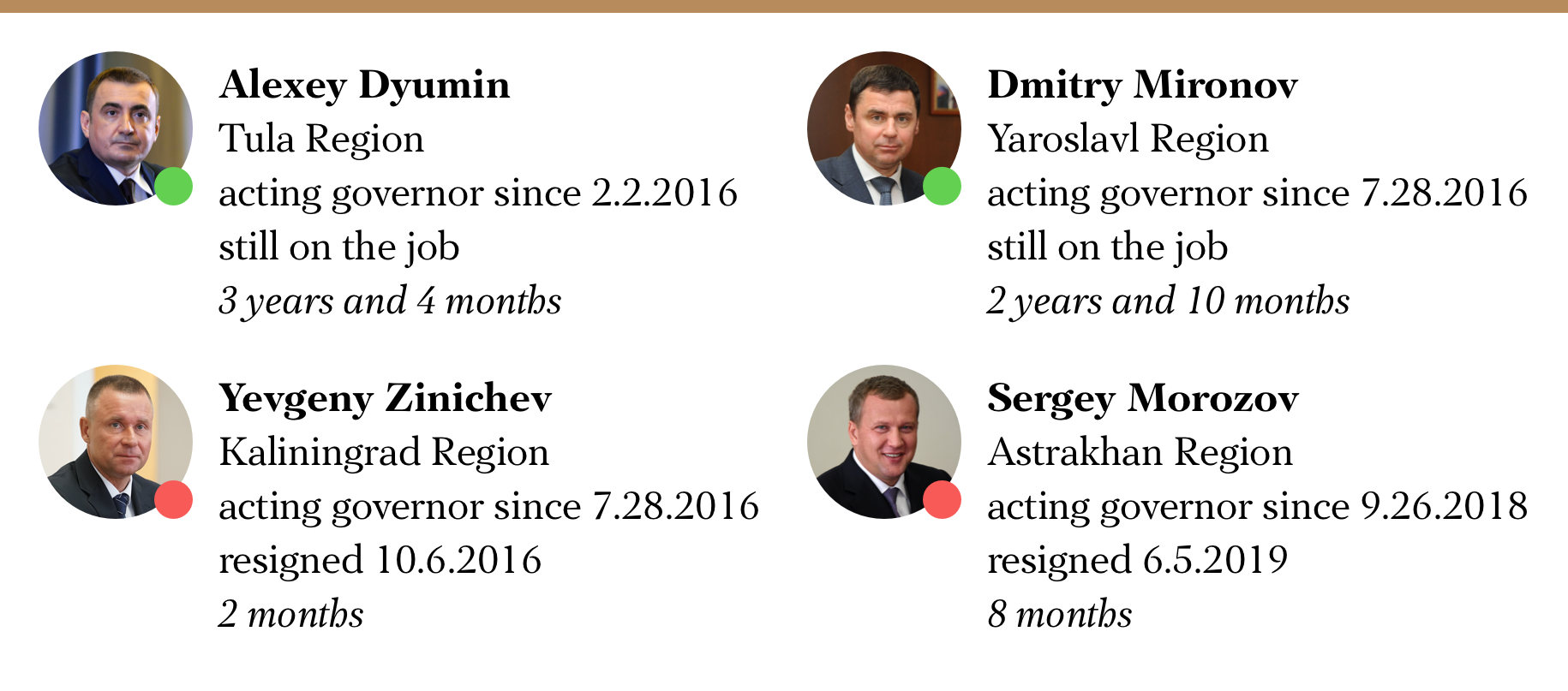
On June 5, Astrakhan Region Acting Governor Sergey Morozov resigned. He was only appointed to the post in the fall of 2018. He will be replaced by Igor Babushkin, the deputy presidential plenipotentiary for the Northern Caucasian Federal District. Morozov, like Alexey Dyumin (Tula Region), Yevgeny Zinichev (Kaliningrad Region), and Dmitry Mironov (Yaroslavl Region), worked in the Federal Protective Service prior to his appointment and was a member of Vladimir Putin’s personal security detail.
‘Censorship has returned to Russia’ 🚫
The Yekaterinburg-based news outlet 66.ru teamed up with local street artist Roma Ink to protest censorship in Russia using a series of graves spray-painted onto the city’s walls. For three nights in a row, the graffiti gravestones mourning various civil liberties appeared and reappeared around the city.
On June 3, a gravestone for freedom of assembly (1993 – 2012) appeared near the square where thousands of protesters gathered in mid-May to protest the construction of a new cathedral. The “birth date” on the graffiti marks the establishment of the Constitution of the Russian Federation, which prohibits censorship and guarantees a series of freedoms for Russian citizens. The “death date” marks the passage of a series of amendments limiting the freedom to protest publicly. By midday, municipal utility employees had washed off the graffiti.
Read Meduza's report: “Yekaterinburg journalists organize a ‘funeral for freedom,’ spray-painting graves for Russians' rights”
Newly renamed A.S. Pushkin Sheremetyevo Airport gets a monument to the groundbreaking poet 🛃
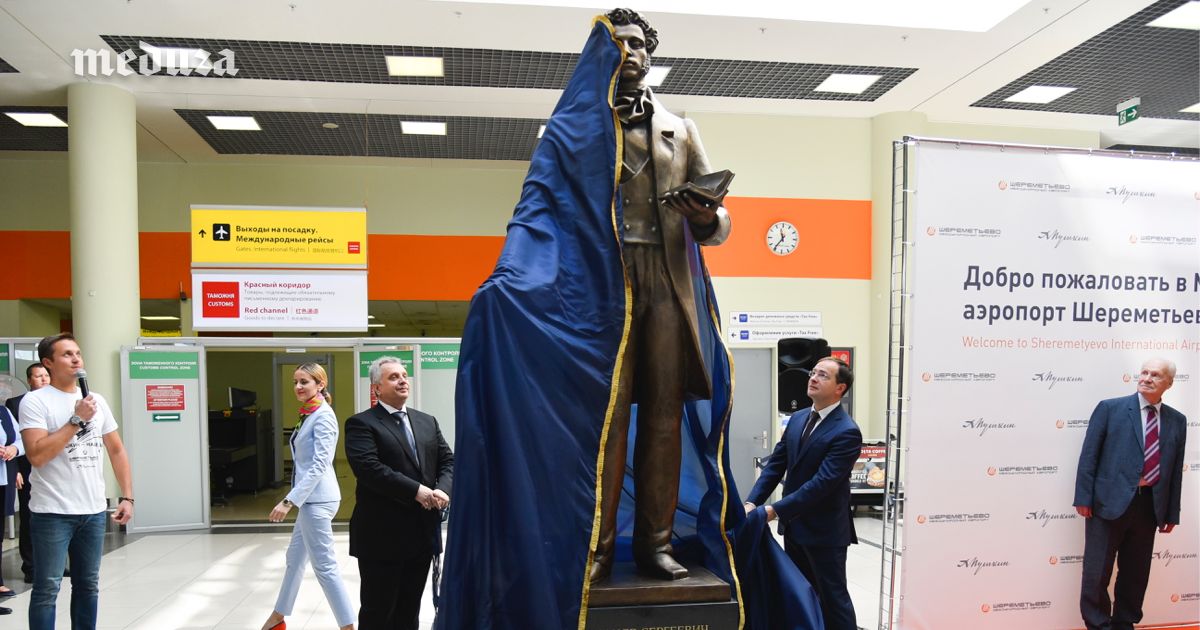
Moscow’s Sheremetyevo International Airport was recently renamed in honor of the poet Alexander Pushkin. To celebrate the change, officials installed a monument to Pushkin inside the airport on June 5. Culture Minister Vladimir Medinsky participated in the monument’s unveiling ceremony. The sculpture itself, created by Alexander Burganov, portrays the poet reciting a poem aloud, the airport’s press service explained. The spine of the book in the poet’s hand features a hidden QR code that allows travelers to download an audiobook of Pushkin’s works. The sculpture joins at least 11 other major monuments to Pushkin in the Russian capital alone.
More arrests follow the murder of a GRU veteran 👮
Federal investigators in Russia have arrested another two suspects in a mass brawl outside Moscow that claimed the life of Military Intelligence Directorate veteran Nikita Belyankin. According to officials, one of the two men is responsible for inflicting the fatal blow.
On June 1, in the town of Putilkovo, 24-year-old Nikita Belyankin was killed. He previously served in Russia’s GRU and fought in Syria. According to eyewitnesses, he tried to stop roughly a dozen men from attacking a few strangers. During the confrontation, someone stabbed him in the heart.
Russia’s Investigative Committee says it will ask a court to jail all four suspects currently in custody, while officials build their case. According to an unverified report by the newspaper Moskovsky Komsomolets, the suspects include Armenian national Narek Stepanyan, Moscow economist Suren Markosyan, and an unemployed man named Sergey Khodzhaev.
✊🏻 Opinion: This killing isn't enough to mobilize Russia's castrated nationalist movement
GRU veteran Nikita Belyankin was killed by a group of Armenians and Oleg Kashin wonders why it hasn’t sparked ethnic riots. In a new op-ed for Republic, the columnist says Belyankin’s murder has all the trappings of a heroic death that should have galvanized the nation: a soldier survives war in Syria, only to die in the arms of his girl, in a peaceful Moscow suburb, at the hands of immigrants. These circumstances, he argues, were sufficient to fuel past ethnic unrest in Kondopoga (in 2006), at Manezh Square (in 2010), and in Biryulyovo (in 2013).
Equating soldiers and immigrants, Kashin compares Belyankin’s killing to the 2015 Gyumri massacre, when a Russian serviceman murdered seven members of a local family. That crime nearly pushed Armenia into revolution, as angry crowds demanded justice for the victims and even jeopardized the country’s alliance with Russia.
Why haven’t Russians responded similarly to Belyankin’s death? Kashin credits Russia’s anti-extremism policing with crippling the nationalist movement that would normally mobilize protests in these cases. Belyankin’s unique circumstances, Kashin says, also minimize the reaction: his Antifa history means the nationalists don’t want him as an icon, and his “ultra-right death” means the leftists will turn away, too.
Opinion and analysis
🕊️ Frolov: The U.S.-Israel-Russia is a chance for Moscow to find out what it's worth to Trump in Iran
John Bolton, Nikolai Patrushev, and Meir Ben-Shabbat will meet in Jerusalem later this month for a U.S.-Israel-Russia security summit, and columnist and former diplomat Vladimir Frolov thinks it will be an opportunity for the Trump administration to make clear to the Kremlin how Russia might be rewarded for facilitating a resolution in Tehran. In a new op-ed for Republic, Frolov says the summit seems like a loss for Moscow at first glance (given that the Kremlin previously hoped for a Trump-Putin meeting this month at the G20 Osaka summit), but the Jerusalem talks could be an opportunity for Russia to offer potentially vital mediation.
Frolov says Russian diplomats are busy persuading Iran to show restraint in its conflict with the United States, and he speculates that Moscow is already working to facilitate direct dialogue between Washington and Tehran. (One of Moscow’s negotiating strategies is apparently trying to convince the Iranians that Donald Trump will be re-elected, meaning that “waiting for a Democrat in the White House” isn’t a wise policy.)
President Putin, moreover, recently warned Iran against withdrawing from the 2015 Joint Comprehensive Plan of Action, implying that it would be on its own against American sanctions, if the agreement collapses. Putin simultaneously signaled that the U.S. should reconsider its maximalist position, noting that Moscow wouldn’t always “put out fires” in Iran. Frolov says the Kremlin even leaked information that Putin personally refused to sell S-400 anti-aircraft missile systems to Tehran, in a signal he says was meant for the U.S., Israel, Saudi Arabia, and the United Arab Emirates.
Russia’s commitment to these negotiations, Frolov argues, is serious. He says Moscow is showing that it’s willing to consider and promote U.S. interests in expanding the parameters of a new agreement with Iran aimed at limiting its regional expansion and aggressive actions through local “allies.” The Kremlin would also like to see Tehran withdraw from Syria, he says.
What does Russia have to gain in all this? Frolov says the Kremlin benefits from the mediation process itself, which increases Russia’s international influence, and the Jerusalem summit will be an opportunity to find out what Washington is willing to deliver in return for this help.
😱 Steshin: Kateryna Kruk’s new job at Facebook is a vatnik nightmare
“Patriotic” columnist Dmitry Steshin is furious about Facebook’s decision to hire former Maidan activist Kateryna Kruk as the company’s new public policy manager for Ukraine. In a new op-ed for Komsomolskaya Pravda, Steshin warns that “a tough time awaits Russian users,” arguing that Kruk’s authority will inevitably extend over Facebook users in all “Cyrillic segments” of the social network.
What’s so terrible about a Ukrainian revolutionary with influence at Facebook? Steshin complains that the company’s public policies are already “a bit anti-Russian” and “absolutely liberal and pro-Western,” promoting core values that “differ slightly” from Russia’s. In practice, Steshin is angry that Facebook prevents hate speech against Ukrainians, mocking the social network’s apparent decision to treat the nationality as a vulnerable group. He says he’s been banned repeatedly, sometimes for posting ethnic slurs against Ukrainians, and sometimes, he claims, for innocuous posts on false pretenses by Ukrainian activists.
Kateryna Kruk’s hiring “confirms that, in the 21st century, social networks have decisively turned into a political tool,” Steshin says. But she faces a challenge, he adds: for the sake of appearances, Kruk will need to avoid an “outright virtual genocide” against Russian users, meaning that she’ll implement a gradual crackdown on whatever “Russians’ distinct core values” are. This, Steshin believes, will trigger a response from Russia’s federal regulator, Roskomnadzor.
News briefs
- 🏆 The council of experts for the Big Book prize, one of Russia’s most prestigious annual literary awards, has named 12 books to the prize’s shortlist for 2019. Read the list here.
- ⚖️ Three former soldiers who were seriously injured at a training grounds outside St. Petersburg in 2017 are trying to sue Russia's Defense Ministry for 6 million rubles ($91,925). Vadim Gabidulin, Arsen Osmanov, and Dmitry Pakhmutov seek compensation for psychological distress and medical bills, their attorney (“Zona Prava” human rights lawyer Dmitry Gerasimov) told Meduza. Read about their lawsuit here.
Yours, Meduza