
The border between good and evil
Why some Russian activists and reporters are no longer allowed to enter Georgia
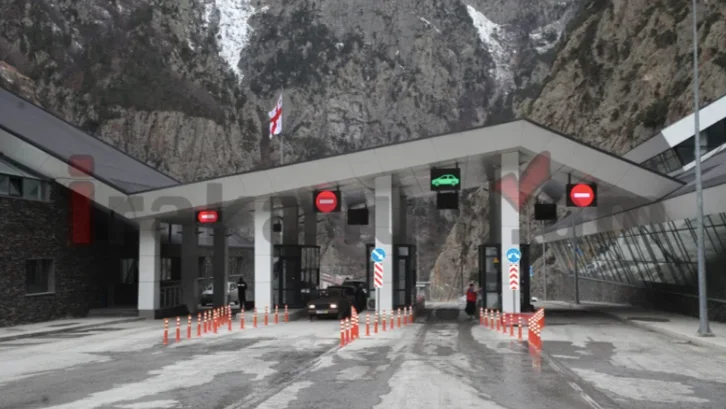
Georgia has become one of the most convenient options for Russians leaving the country since the start of the war in Ukraine. Some come to Georgia to avoid unfair criminal persecution, some want to save themselves from being drafted into the army, some just want to escape the propaganda and the lack of stability. There are no visa restrictions for Russian citizens in Georgia. The weather is lovely, many locals speak Russian, and the country has a favourable business climate and rich culture. All COVID-19 border restrictions have recently been lifted: it is now possible to reach Georgia by car from mainland Russia. All these factors attract scores of 21st-century Russian immigrants. But recently, there have been more and more cases of people who got turned away at the border of this friendly and welcoming country. Novaya Gazeta. Europe has collected their stories.
“They didn’t ask me many questions. They didn’t ask to see anything. They weren’t really interested in anything, no questions were asked, they just told me to wait and that’s it. I had to wait 14 hours, they only told me I could take my passport and go back if I wanted,” David Frenkel, a photojournalist at Mediazona news outlet who was turned away at the Georgian border in March, recalls. “They didn’t know anything themselves, they even apologised at some point that it’s not up to them, they are waiting for a response from higher-ranking officials. Fourteen hours later they told me that the response was negative.”
According to the stories of other Russian citizens who tried to enter Georgia, the border guards also filed requests to check their names in a database. At first glance, there were no formal reasons to refuse entry to Frenkel: according to the journalist, he had not visited South Ossetia nor Abkhazia (breakaway states in the South Caucasus recognised by the UN and the Georgian government as part of Georgia — translator’s note). “Besides, I visited Georgia six months before that, there were no problems,” he added.
Entry rules for Russian citizens travelling to Georgia
Citizens of the Russian Federation can come to Georgia and stay there without a visa for a year. After a year, Russian citizens must leave the country or get a temporary or permanent residence permit at the Civil Registry Agency.
No visa is required for entering the country, a foreign passport is enough. Citizens who entered Abkhazia or South Ossetia from Russian territory may face problems, as Georgia introduces criminal liability for that according to local legislation regarding occupied territories.
Several days before that, journalist Mikhail Fishman, who flew in to Tbilisi with his children, was also turned away at the border.
“The whole thing took about 90 minutes. The border officials asked me if I had a return ticket. They didn’t ask any more questions. Unfortunately, we weren’t able to appeal this decision in time,” Fishman recalls.

Both reporters are confident that they were refused entry to the country due to their line of work.
“I have no doubt that the only reason is my work as a journalist in Russia. I know dozens of cases when people were refused entry, and another several dozens of cases when people spend hours waiting at the border, but are then granted entry. All these people could somehow have ended up in the Russian government’s area of interest. Although some of them are not in the public eye at all, so it is doubtful that the Georgian government googled them somewhere. I’ve also heard of specific questions, for example, regarding their participation in some political movements in Russia,” Frenkel said.
He noted that many of his acquaintances who have lived in Georgia for a long time do not want to leave the country, fearing that they would not be allowed back. Recent immigrants suggest that showing a long-term lease agreement to border officials could help influence their decision. However, this did not help Olga Borisova, a member of Pussy Riot. On 20 July, the woman was returning home after the band’s European tour, where she spoke out in support of Ukrainians affected by the war. She rents a flat together with her boyfriend, who was waiting for her at home, in Tbilisi.
“When I flew in, I handed my passport to a border official, as usual. I noticed the woman at the passport control take a picture and send it to someone. I waited for about 30 minutes, and then I was told that I am not allowed to enter the country. They put me back on the plane and sent me to Istanbul and then to Amsterdam, where I originally left from,” she said.
Unlike Fishman and Frenkel, Borisova is confident that this is just a misunderstanding that will be resolved soon: “It’s hard for me to say that it’s because of the pro-Putin government, because many people are allowed to enter, after all. It’s just that the mechanism isn’t honed yet: no one expected the war and such an influx of people from Russia, including activists, people who actually have an influence on politics. I hope that this will be fixed soon, I really want to come back.”
The member of Pussy Riot does not rule out that she was not allowed to enter Georgia because of her long-time personal hater Igor Bendega, who has been stalking the woman on social media for over 10 years. Twitter user @Kyen77788 previously boasted that he had warned the Georgian law enforcement and border guards that Borisova was allegedly planning a terrorist attack.
“Well, actually, I didn’t just contact them on Facebook, there were several e-mails, I don’t remember the institutions, but it was the Interior Ministry, the border service, the police. I don’t know which one worked,” the user writes.
It is unclear whether the decision to refuse Borisova entry to Georgia is connected to Bendega reporting her to the police. In all three of the cases mentioned above, border officials did not provide a specific reason for their decision. The Georgian Interior Ministry has the right to do that according to the Georgian law.
However, the ministry chose to explain the situation with Russian blogger Insa Lander, who has spent nearly two weeks in the neutral zone between Georgia and Russia. Georgian officials stated that she might present a threat to the country’s security, as there is a terrorism case opened against her in Russia.
“If a person is persecuted for international crimes, such as terrorism, drug trafficking, human trafficking, then this person may be refused entry to Georgia in the interest of the state,” the Interior Ministry stated.
For her part, Lander says that the charges against her are politically motivated.
Novaya Gazeta. Europe is aware of at least five cases of Russians with an active political stance being refused entry to Georgia.
What do legal experts think of the situation?
Experts quizzed by Novaya Gazeta. Europe do not consider these cases politically motivated.
“I am helping a lot of people arriving in Georgia and I know that there is no blacklist of opposition figures, and there never has been. This is a technical issue of the Interior Ministry. The main factor behind the entry bans is the lack of a transparent system,” head of Free Russia Foundation Egor Kuroptev said. “There is no clear understanding in Georgia what documents are required for a person to enter the country. In order to get a European visa, you need to get insurance, take ID pictures, and collect a clear-cut list of documents. Georgia doesn’t have a system like that, there are no visa requirements for Russians.”

The expert points out that due to the visa-free regime between Russia and Georgia, border officials tend to be stricter, as there are no preliminary background checks. Besides, after the start of the war in Ukraine, the number of Russians wishing to enter Georgia has skyrocketed. And the number of entry refusals has also risen, although such cases did happen even before the war.
“There is a large influx of people who are not activists and have nothing to do with politics. And many of them are not allowed to enter the country. But even among the activists, many do end up entering Georgia,” Kuroptev says. “Terrorism charges are another thing. You need to prove without a doubt that they are not true [and that you were not actually involved]. If there is an open terrorism case against you, you need to arrive at the border with a full package of documents that explain why you need to be let in and why you have nothing to do with these charges. Once again, these are one-off cases: dozens, hundreds of people who are currently persecuted in Russia come to Georgia without any issues. Yes, they may be held up at the border for a couple of hours to answer questions about the purpose of their visit, about who they are in contact with, where they are going. Yes, it gets stressful, but they are allowed to enter the country in the end.”
Legal expert Nika Simonishvili with the Georgian Young Lawyers’ Association (GYLA) also laments the lack of a clear and transparent system of entry rules. However, he does not rule out that Georgian border officials may have a blacklist.
“The police say: you cannot enter Georgia. And there is no explanation. In the majority of cases, this concerns citizens who are on the Georgian security service’s blacklist. These people’s line of work is often tied to criticism of the Kremlin and the government. When Mikhail Fishman was refused entry, we demanded the officials to explain why. But they didn’t. I think that at times, the Georgian government is afraid of doing something that could provoke a negative reaction from the Russian government. However, no one talks about it at an official level, and there are no official explanations for that, unfortunately,” he notes.
What was it like before the war?
A number of Russian opposition figures and independent reporters were turned away at the Georgian border even before the war. For example, attorney and Navalny ally Lyubov Sobol said that she was not allowed to enter Georgia last August. According to her, there was no official reason provided for that decision.
“I’ve never been to Abkhazia, and I never did anything that could be considered unfriendly. I have many acquaintances in Georgia, I like the country, its culture and language. And this decision was hurtful and upsetting to me, personally,” she told Dozhd TV channel.
The same thing happened to Russian politician Dmitry Gudkov, who tried to enter Tbilisi in late January, arriving from Kyiv.
“A decision was made at the state level to deport me. The decision was political. Everyone was notified of my visit; I came on an official invitation. There were meetings planned with activists and diplomats. There was no explanation, just sympathetic gestures from the border officials,” he said.
Gudkov has not received an official explanation for this decision to this day. “According to the law, the officials have the right not to state the reasons. The decision was taken at the top level at the very last moment. As I was told, the Georgian government does not want to fight with Putin. So just in case, they do not allow people who are not favoured by Putin to enter the country and deport them,” he told Novaya Gazeta. Europe.