
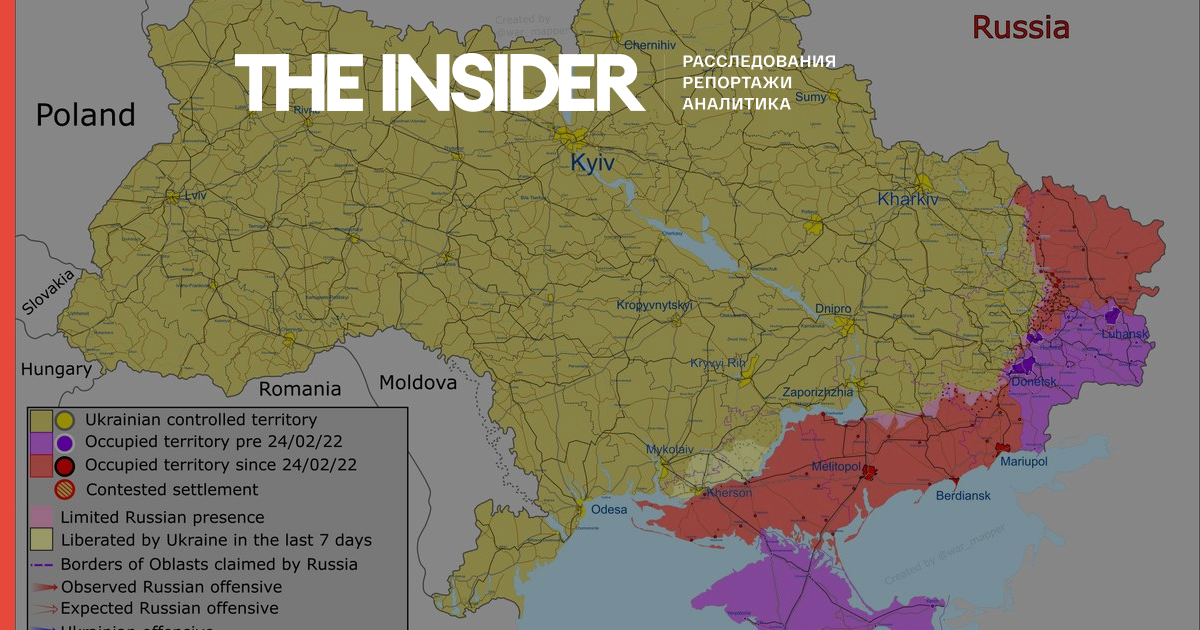
AFU reinforcing Zaporizhzhia sector, mined police directorate blown up in Kherson. What’s happening on the front line?
Response to missiles downed in Poland
The US president Joe Biden has informed his NATO and G7 partners that yesterday’s explosions in Poland were caused by a missile fired by Ukrainian air defense. He believes it is “unlikely” that the missile was fired by Russia. The Russian Ministry of Defense also asserts that the missile was part of a Ukrainian S-300 air defense system. Ministry spokesperson Igor Konashenkov stated that on November 15, Russia had only carried out “high-precision strikes” on Ukrainian targets “no closer than 35 kilometers from the Polish border”. The distance matches the location of the Dobrotvirska CHP and a power transmission line to Zamojsce (Poland). The possible motivation behind the strike on the CHP was the desire to prevent Poland from supplying energy to Ukraine.
The White House declared its agreement with Poland on the assessment that the missile originated from a Ukrainian air defense system. However, Biden's administration places the blame for the incident on Russia.
“That said, whatever the final conclusions may be, it is clear that the party ultimately responsible for this tragic incident is Russia, which launched a barrage of missiles on Ukraine specifically intended to target civilian infrastructure. Ukraine had — and has — every right to defend itself.”
NATO Secretary General Jens Stoltenberg stated that the alliance had not observed any signs of Russian preparing offensive military action against NATO. According to him, the missile that crashed in Przewodow had been fired by a Ukrainian air defense system. Stoltenberg added that it was too early to make conclusions with the investigation still in progress. However, assured he, the alliance had no intention of invoking Article Four of the Treaty. On the night of November 16, Ukrainian president Volodymyr Zelensky announced that Poland had been hit by a Russian missile.
Oleksandr Kochetkov, a weapons expert and missile engineer, has explained to The Insider that, while it may be unclear whose missile had crashed in Poland, it most likely belonged to Ukrainian air defense. His interpretation of the causes includes Ukraine’s outdated means of air defense and Russia’s inability to deliver precision strikes due to a lack of military-grade microchips.
“During the massive missile strike, air defense systems were pushed to the brink of their capacity; human factor may have also been at play, but technology played a more important role. S-300 missiles, which bear the brunt of Ukraine's air defense needs, are in truth fairly outdated. As for Russian missiles, I can say the following: while they used to hit Ukrainian targets with a precision of three to five meters, which is more or less a precision strike, we now see margins of error of 300 meters or more. This happens because Russia used to procure military-grade microchips for its control systems, protected from overload and temperature fluctuations, and now has to use gray schemes and scramble for microchips from household appliances like masseurs and breast pumps.
In terms of computational capacity, you can use them to guide a cruise missile, but in terms of reliability, they are subpar. The reliability of Russian missiles has plummeted, as we saw in the recent case of an Iskander crashing in Zaporizhzhia without exploding. As a missile engineer, I wouldn’t be surprised to learn that one such missile lost its target, with a Ukrainian air defense missile following it [into Poland]. This is the most rational technical explanation. Whose missile it was is of little importance. Under any international norms, the responsibility for all events that unfold during an unleashed aggressive war lies with the party that unleashed it. No matter if the destruction was caused by a Ukrainian, Polish, or someone else’s missile; the blame lies with the aggressor who started the war. This understanding is shared by European leaders and all reasonable people, and they emphasize their position.
Ukrainian leaders urge to close the sky above the country. Of course, this will never happen because this measure implies the use of fighter aviation, in particular, flying closer to the anti-missile operations area. This increases the risk of immediate military contact between NATO representatives and Russia – an outcome NATO would prefer to avoid. However, after experiencing this tragic incident, Poland will take steps to ensure proactive protection of its borders, including aerial ones. I won't be surprised in the least if Polish anti-missile defense will take it upon itself, with support from the US, to intercept missiles headed toward Poland at a distance of 100-150 kilometers away from its border. It won't be Ukraine they will be protecting from Russia’s missiles but their own territory.
Such a step does not suggest the deployment of NATO armed forces in Ukraine or direct engagement with Russian planes or air defense. It is a possibility, and a logical one, offering Ukraine additional air defense capabilities in the short term. Sweden, a high-tech nation, has already responded to Ukraine's plea for help and is supplying us with such systems. One could suggest they are short to medium range. Other countries will make up their minds and expedite the shipment of weapons that can help us protect our sky from Russian missiles. The next stage is securing broader support for Ukraine now that missiles have landed in a NATO country.”
Russia's massive missile attack on Ukraine on November 15 cost the aggressor $700–900 million, by the estimates of Ukrainian Forbes. Russia launched a total of 90 missiles (70 Kh-101/Kh-555 cruise missiles and 20 Kalibr missiles) and 10 suicide drones.