
Influencer operation
A cohort of pro-Kremlin content creators is shamelessly portraying the Russian occupation of Mariupol in a positive light
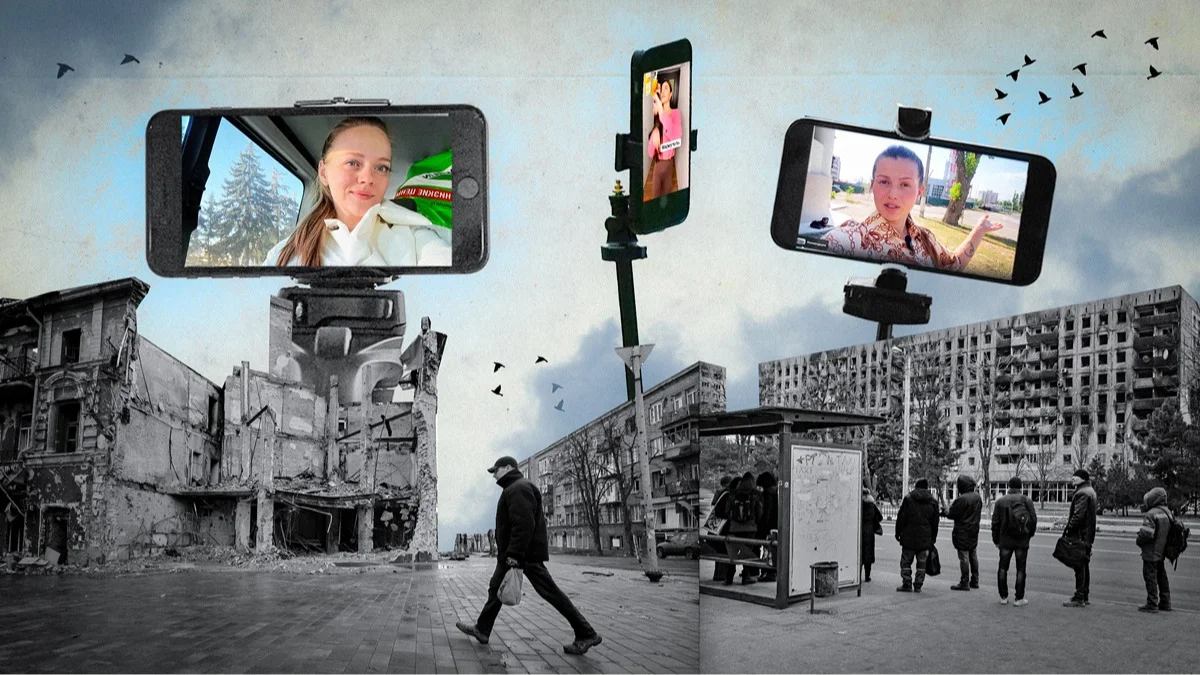
Illustration: Novaya Gazeta Europe
In 2022, the Ukrainian port city of Mariupol was almost wiped off the face of the earth during a months-long siege by Russian forces that left thousands of civilians dead. One of the most potent images of that time was a photograph of a pregnant young woman with blood on her face being evacuated from a maternity hospital that had just been bombed.
That woman was Marianna Vyshemyrska, and despite that image of her at one point being synonymous with Russia’s indifference to the suffering of civilians in Ukraine, she has become one of many Mariupol-based content creators to have taken a pro-Kremlin stance since the city’s fall to Russian forces in May 2022. Vyshemyrska now regularly gushes online about the new homes being built in the ruins of her destroyed hometown, while others laud “our president, Vladimir Putin” and even report on their vacations in annexed Crimea.
Changing sides
Like countless other Mariupol residents, Vyshemyrska has been forced to endure horrendous events since the Russian invasion began, and witnessed her home town practically being reduced to rubble during the fighting that took place in early 2022. According to the UN, approximately 90% of Mariupol’s residential buildings were damaged or destroyed in just a few months.
The International Committee of the Red Cross has described the Siege of Mariupol as “apocalyptic”, with civilians forced to live for months without electricity, water, heating, communications or adequate food and medicine. Human Rights Watch has laid the blame for what happened with the Russian army.
When the now famous images of the pregnant Vyshemyrska fleeing the ruins of the hospital wrapped in a blanket and with a bloodied forehead were shared around the globe in March 2022, Russian state media immediately accused the Ukrainian authorities of staging the bombing, and claimed that Vyshemyrska was an actress.
Speaking to the BBC a few months later, Vyshemyrska confirmed that she had indeed survived an explosion at Mariupol Maternity Hospital No. 3 and denied that the photo had been staged. Describing herself as apolitical and being careful to avoid blaming either Ukrainian or Russian forces for the attack, she also said that she had never given her consent to the Associated Press for the photo that caused such commotion online. After the hospital strike, Vyshemyrska moved to the regional capital Donetsk along with her husband and newborn daughter.
Before the war, Vyshemyrska reportedly did some modelling work and collaborated with cosmetics brands on Instagram, where she had nearly 84,000 followers. The account is now private and all posts have been deleted, but Vyshemyrska continues to generate income online, albeit in a rather different way.
“Not that long ago, there was nothing here. And now there are apartments full of happy people.”
On a new Telegram channel that she launched after the Russian invasion, Vyshemyrska began to write about the Ukrainian shelling of Donbas, which she blamed on Ukraine and NATO, and began commenting on international politics, including prisoner exchanges, NATO statements and even meetings between Ukrainian President Volodymyr Zelensky and European leaders.
Though most of her content was made up of reports about public transport, water and electricity supplies, mobile networks and the construction of new homes in Mariupol, she also found time to promote Russian propaganda channels.
Houses built on bones
“Not that long ago, there was nothing here. And now there are apartments full of happy people,” says a young woman on a now deleted TikTok video as she stands in front of recently completed buildings in Mariupol in a part of the city that was almost completely destroyed in 2022. Hundreds of comments under the video point out that the new homes have been built on bones.
Meet 23-year-old Maria Chushykina, who creates content about life in the Russian-occupied city as Masha from Mariupol. According to Chushykina, she at one point had as many as 120,000 subscribers on her first YouTube channel, but says that it was deleted five times. Now she mainly devotes her time to a Telegram channel with about 4,000 subscribers and a channel on RUTUBE, a Russian answer to YouTube, which also has roughly 4,000 followers.
In another video, Chushykina talks about the Russian restoration of central Mariupol, noting that the city had never had such “cool playgrounds and sports facilities” before, and the improvements were all thanks to “our president, Vladimir Putin”. In a video about the Mariupol Drama Theatre, in which at least a dozen civilians were killed in a Russian airstrike in March 2022, Chushykina says “a lot of people died here due to the Ukrainian nationalists’ bombs”.
Benjamin Shultz, a disinformation researcher at the American Sunlight Project, which exposes misleading online information, told Novaya Gazeta Europe that based on his analysis, all bloggers from Mariupol “receive marching orders or guidance from some central entity”.
Shultz noted that many Mariupol content creators talk about specific topics in almost the same way. For example, when bloggers talk about the Left Bank in Mariupol, they repeat a narrative that an area that once saw fierce fighting is now “full of life”. They also show the city beach or the city’s historic centre and say that Ukraine did nothing to improve it and renewal only began under Russian rule.
Friends in high places
Though Novaya Gazeta Europe has found no direct evidence that the content creators working so hard to create a positive image of Mariupol under Russian occupation have received Kremlin funding, Vyshemyrska does appear to have some significant links to influential people.
Among those she is close to is the former deputy governor of Russia’s Central Bank Alexander Torshin, who also represented the Republic of Mari El in the Federation Council, Russia’s upper house of parliament, for 14 years, and Oleg Khusnullin, a Russian official with a murky past who calls Torshin his “friend and mentor”.
Torshin is best known for having been the handler of Maria Butina, a former Russian spy who served an 18-month prison sentence in the US for acting as an unregistered foreign agent, who is now a member of the State Duma, Russia’s lower house of parliament. Since her return to Russia in 2019, Butina has been a Russian propaganda mouthpiece, and recently became the face of a campaign promoting “ideological” visas for foreigners, aimed at attracting citizens of Western countries to Russia.
Khusnullin, who is also frequently mentioned in Vyshemyrska’s posts, keeps his cards close to his chest, presenting himself variously as an aide to an unnamed Russia senator, a representative of the mufti of the Russian-occupied Luhansk region in eastern Ukraine, an advisor to the head of the Volga region republic of Chuvashia, as well as the director of government relations for construction company House Group.
“No blogger would be independent and not have had a knock on the door within a month explaining the rules.”
However, it appears likely that Khusnullin went by a different name in the past. In December 2023, Khusnullin launched a personal website, which soon stopped being updated and is now inaccessible to visitors. His biography, which was published on the website, has proven impossible to verify, and he has no registered phone, car or flat.
Novaya Gazeta Europe has found that Vyshemyrska has been receiving money over the past three years through House Group, where Khusnullin serves as the government relations director, and two other companies he claims to represent.
Neither Vyshemyrska, Khusnullin nor Torshin responded to Novaya Gazeta Europe’s requests for comment.
Stick over carrot
In most cases, media control in Mariupol is exerted primarily through force, not money, according to the head of the Centre for the Study of Occupation Petro Andryushchenko, who previously advised the now exiled former mayor of Mariupol. “No blogger would be independent and not have had a knock on the door within a month explaining the rules,” he says, adding that, according to his sources, there is a Federal Security Service (FSB) agent working in the city administration who is tasked with controlling the local media.
Andryushchenko also noted that before the Russian occupation, Maria Chushykina’s husband Ivan was a well-known Mariupol activist and Ukrainian nationalist who opposed the Donetsk People’s Republic (DPR) and its efforts to declare its independence from Kyiv, and even served as a Ukrainian border guard.
After the occupation, Ivan’s political stances changed drastically — likely after the occupation authorities put pressure on him, Andryushchenko suggests. Now, Ivan is vehemently critical of pro-Ukrainian content creators and uses his Telegram channel to voice his support for the Russian occupation authorities.
Novaya Gazeta Europe requested an interview with Chushykina, but she stopped answering our messages when she learned that Novaya Europe does not pay its interviewees.
Propaganda training
Masha from Mariupol’s content began to look more professional in late 2024, with her average views going from hundreds to thousands. At the start of each video, Masha said that she worked for the pro-war Telegram channel Telega Online, which, as well as interviewing pro-Kremlin Russian politicians, also runs exposés of celebrities who oppose the war.
New content creators began to sprout “like mushrooms” in the wake of the Russian invasion.
Konstantin Dolgov, a political strategist who was sacked from the project, says it is supervised and financed by the Institute for Internet Development (IRI), a state-sponsored Russian non-profit sanctioned by the EU for spreading Russian propaganda online. Last year, IRI distributed 20 billion rubles (€221 million) in grants, some of which went to content creators covering the war from occupied regions of Ukraine.
Mykola Osychenko, the director of Mariupol Television from 2019 to 2022, says that though the occupation completely destroyed local media in Mariupol, new content creators began to sprout “like mushrooms” in the wake of the Russian invasion. The new authorities began to conduct master classes, open schools, and take bloggers to Moscow for media training.
The Donbas Media Centre (DMC), a vocational school for wannabe journalists under 25, opened under the guidance of experienced content creator mentors in the occupied city of Luhansk in February 2024. Here, totally free of charge, the students are taught how to shoot snappy videos and ways to grow their social media presence. After opening a second campus in Melitopol, in the southeastern Zaporizhzhia region, the DMC opened a third school in Mariupol in September.
According to Russian tabloid Moskovsky Komsomolets, the DMC works in cooperation with RUTUBE, Russia’s answer to YouTube, which is in turn owned by Gazprom-Media, a major media holding controlled by Rossiya Bank — a sanctioned joint stock bank whose shareholders include some of Putin’s closest friends and relatives.
‘I’m pro-Russian, not a propagandist’
Novaya Gazeta Europe reached out to several Mariupol creators who have been posting pro-Russian content since the city’s occupation began in 2022, but almost everyone ignored the messages. However, one blogger from Donetsk who makes videos about how Mariupol is improving under Moscow’s control did agree to answer our questions.
Pavlo Karbovsky, who also works as a mentor at the DMC, told Novaya Europe that his first TikTok account, which he created in September 2022, was more political, but was removed after “complaints from Ukrainians”.
“Is propaganda necessarily bad? … Propaganda just means informing people about something.”
“I wanted to tell people what was happening in the DPR. I wanted to give specific examples of shelling and explain that things were pretty scary. But we’re still having a great time and enjoying life,” he said.
Proud of his pro-Russian stance, Karbovsky describes Ukrainians and people in the West as living in an “information bubble” created by both their media and their governments. When asked if he admits to being a Russian propagandist, he responds by saying that he’s “pro-Russian, not a propagandist,” but also asks “is propaganda necessarily bad? … Propaganda just means informing people about something.”
Another blogger, Vasylysa Belyakova, who initially fled Mariupol for Germany when the Russian invasion began, explains that she and her family ultimately returned to their home town as they saw no future for themselves abroad.
Belyakova became active on TikTok soon after her return, making content in which she unfavourably compared Germany and Mariupol, even claiming that there was no justice in Germany, where she also claimed water was rationed, while denying that there were any issues with Mariupol’s water supply.
“Of course there are people who condemn my choice, but there are others who understand that I have returned to the only home I have on this planet,” Belyakova says.
The new abnormal
“The city was wiped out over the course of a few months. Many people lost their children, loved ones, neighbours. That pain will remain part of the city forever,” Belyakova admits, taking care not to specify who exactly was to blame for the destruction of the city.
But most Mariupol-based content creators these days tend to skip over details of the city’s destruction and focus instead on all the Kremlin-funded urban renewal and ambitious reconstruction projects instead.
“Talking about normal life, overlooking the situation which made life abnormal in the first place, plays into the hands of the occupier.”
“Talking about normal life, overlooking the situation which made life abnormal in the first place, plays into the hands of the occupier,” says Serge Poliakoff, a disinformation researcher at the University of Amsterdam.
The goal of the Kremlin is to sow the seeds of doubt among less politically involved people by creating “casual content” about the reconstruction of the destroyed city, thus creating a “positive image” of Russia, Shultz agrees.
The Russia-curated content from newly rebuilt Mariupol often prompts comparisons to Moscow and its mayor Sergey Sobyanin, who is known for his ambitious urban development projects.
“Sobyanin’s Moscow is seen as a paragon of stability and comfort for a country at war,” Poliakoff notes. “But there’s a difference — Mariupol’s been built over bombed out residential areas, and its former tenants are buried in its courtyards.”